
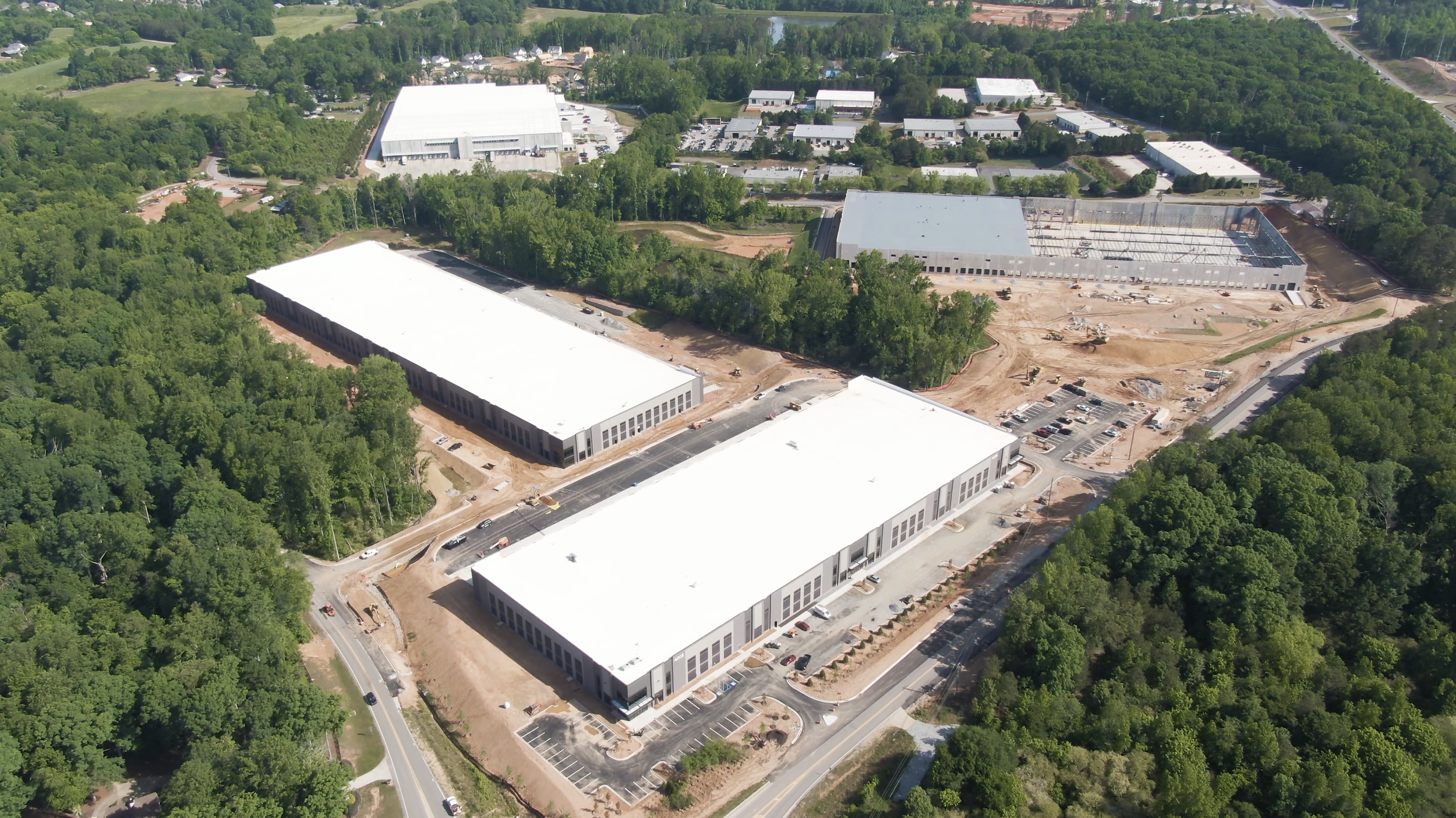
Coal Mountain Industrial Park
— June 01, 2026 // Hunter Aiken, Vice President, Investments
I recently attended NAIOP I.CON East and came away with a consistent message from developers, operators, capital providers, and tenants: industrial real estate is entering a more operationally intensive phase of the cycle.
The broad fundamentals for industrial remain attractive, but the factors driving performance are becoming more nuanced. Power availability, automation requirements, operating capability, and infrastructure readiness are increasingly determining where capital flows and which projects move forward.
Several themes surfaced repeatedly across the conference:
Power is becoming the primary constraint in industrial development
AI is beginning to materially affect both operations and transaction execution
Small-bay industrial continues to see strong demand, but success depends heavily on operating systems and leasing execution
Manufacturing and onshoring trends remain supportive, although growth is uneven and highly concentrated around specific sectors and geographies
The common thread across all of it was clear: industrial is no longer a simple “land and box” business. Execution capability is becoming increasingly important.
Power is becoming the defining variable
For most of the last decade, industrial site selection was driven primarily by population growth, labor availability, transportation access, and proximity to major logistics nodes. Those variables still matter, but power availability is rapidly moving to the forefront.
That shift is being driven by several overlapping trends:
AI infrastructure and data center development are significantly increasing grid demand
Industrial tenants themselves are becoming more power-intensive as automation expands
Utility timelines and interconnection constraints are beginning to directly affect development feasibility and lease-up assumptions
One of the more notable takeaways from the conference was how frequently power surfaced in investment discussions. It is no longer treated as a secondary diligence item. In many markets, it is becoming the gating factor.
Markets with scalable, reliable power infrastructure are likely to separate themselves over the next several years. Conversely, some historically attractive industrial markets may struggle to support future growth simply because the infrastructure cannot keep pace.
There is also an important second-order effect developing. Data center investment creates incremental industrial demand around it. Electrical contractors, equipment suppliers, cooling infrastructure providers, maintenance groups, and other supporting users all require industrial space near those projects.
From an investment standpoint, several implications stand out:
Power-ready sites will continue to command a premium
Grid capacity and utility delivery timelines need to become part of core market-selection criteria
Industrial and data center users are increasingly competing for the same entitled land in certain corridors, which will continue to affect land pricing and replacement costs
In many respects, power availability is becoming the new location advantage.
AI is beginning to impact both buildings and workflows
The conference discussion around AI was notably more practical than theoretical. The focus was less on broad technology narratives and more on how AI is already influencing development, operations, and transaction execution.
The impact is showing up in three primary areas:
Increased infrastructure demand tied to AI-related capital investment.
Changes in tenant requirements driven by automation and technology adoption.
Greater use of AI tools throughout the acquisition and diligence process.
On the tenant side, automation readiness is becoming increasingly important. Higher electrical capacity, additional infrastructure redundancy, and more sophisticated operational requirements are moving into the standard specification set for many users.
Several operators also discussed the impact this is having on lease structures. As tenants invest more heavily in automation and facility improvements, there is increasing pressure for longer lease durations to support return thresholds on invested capital.
The more interesting conversations, however, centered on AI-enabled diligence and transaction execution.
Legitimate use cases are already emerging:
Initial portfolio screening and risk triage
Zoning and entitlement review
Lease abstraction and document analysis
Data room organization and revision tracking
Environmental and reporting workflow management
Used appropriately, these tools can materially improve efficiency and compress transaction timelines.
At the same time, several speakers emphasized that verification risk remains significant. One example cited involved an AI platform incorrectly identifying environmental contamination that did not exist. The broader point was straightforward: AI can accelerate workflows, but it cannot replace judgment or validation.
That distinction matters. The competitive advantage will not come from simply “using AI.” It will come from building disciplined processes around where AI can improve efficiency and where human oversight remains critical.
The firms that benefit most are likely to be those that combine automation with strong execution and governance standards.
Small-bay industrial is an operating business
Small-bay and micro-bay industrial received substantial attention throughout the conference from both investors and operators.
The most important takeaway was that this product type behaves very differently from traditional big-box industrial. In many ways, it operates more like a multifamily business than a conventional warehouse model.
Tenant sizes are smaller, leasing cycles are shorter, and operational intensity is significantly higher.
Several operators described demand patterns in which tenants often need occupancy within 30 days rather than planning years in advance. Leasing activity tends to be more transactional and service-oriented, particularly among smaller businesses using warehouse space for the first or second time.
That dynamic creates a very different operating model.
Success in small-bay industrial depends less on individual lease negotiations and more on systems, leasing velocity, responsiveness, and property management execution.
A few themes came up repeatedly:
In-house leasing is often more effective than relying exclusively on third-party brokerage relationships
Frictional vacancy is normal and should be underwritten accordingly
Tenant onboarding and customer service requirements are materially higher than in traditional industrial product
Standardization and process discipline matter more than one-off deal execution
Institutional interest in the space continues to grow because the demand base is broad and obsolescence risk is generally lower than in larger-format product. However, the operational requirements are also significantly more demanding.
That operational complexity is likely part of the opportunity.
Onshoring and manufacturing demand remain real, but uneven
The conference also included extensive discussion around manufacturing growth and onshoring trends.
The overall conclusion was that the trend is real, although execution remains uneven and highly dependent on sector exposure.
Manufacturing construction activity has increased meaningfully over the last several years, particularly across aerospace, defense, semiconductor, and energy infrastructure categories. At the same time, industrial production growth has not yet fully matched the pace of announced investment.
In practical terms, capacity is being built ahead of realized output growth.
Several speakers also highlighted how sensitive large manufacturing projects remain to policy clarity, incentives, and infrastructure availability. Changes in trade policy, permitting timelines, and subsidy programs continue to influence site-selection decisions in a meaningful way.
One of the more interesting points discussed was the increasing importance of industrial clusters.
Historically, low-cost land and incentive packages often drove manufacturing site selection. Today, ecosystem depth appears to matter more. Access to suppliers, specialized labor, transportation infrastructure, and supporting industries increasingly drives decision-making.
That dynamic favors established industrial and manufacturing corridors over purely low-cost alternatives.
Aerospace and defense were consistently cited as areas of particularly strong momentum, supported by both geopolitical considerations and increased federal spending. AI infrastructure and power-related manufacturing investment were also viewed as durable demand drivers.
EV and clean energy development, however, appear more volatile. Multiple speakers referenced project delays, redesigns, and changing capital allocation priorities tied to shifting policy frameworks and demand uncertainty.
From a real estate perspective, several implications stand out:
Entitled, infrastructure-ready land continues to become more valuable
Manufacturing, industrial, and data center users are increasingly competing for the same labor pools and utility infrastructure
Construction costs remain vulnerable to both labor pressure and tariff-related material inflation
Markets with established industrial ecosystems are likely to outperform markets competing primarily on cost
Capital markets remain constructive, but more selective
The capital markets discussions were generally constructive on industrial real estate overall.
Debt and equity capital remain available, and industrial continues to be viewed favorably relative to most major asset classes. However, underwriting discipline remains intact, particularly around rent growth assumptions and lease-up expectations.
Several themes emerged consistently:
Investors continue to favor smaller-format industrial in many markets due to broader tenant demand and lower long-term obsolescence risk
Development is becoming more selective, particularly where infrastructure constraints exist
Mid-bay product in infill and population-driven markets continues to attract interest
Operating capability is becoming increasingly important to value creation
There was also significant focus on execution-oriented value creation strategies, including lease-up, mark-to-market opportunities, and office reduction within industrial assets.
The broader takeaway was that industrial investing is becoming more asset-specific and submarket-specific than it has been over much of the last cycle.
Simply having industrial exposure is no longer enough. Selection and execution matter more.
Final thoughts
Industrial real estate remains one of the most compelling institutional asset classes, but the drivers of performance are evolving.
Power availability is becoming a core underwriting variable. AI is beginning to influence both building requirements and transaction execution. Small-bay industrial continues to demonstrate strong fundamentals, but success depends heavily on operating capability. Manufacturing growth remains supportive, though capital and demand are increasingly concentrating around specific sectors, infrastructure corridors, and supply chain ecosystems.
The common thread across all of these trends is increasing complexity.
For much of the last decade, industrial performance benefited from powerful macro tailwinds. Going forward, I believe the differentiators will increasingly be infrastructure access, operating capability, and execution discipline. The winners are likely to be the groups that can consistently solve challenges around power delivery, automation readiness, leasing velocity, entitlement risk, and operational scale.
In many respects, the industrial sector is becoming less about broad market exposure and more about the ability to execute at the asset, submarket, and infrastructure level.
At Holder Properties, we're spending a significant amount of time evaluating how power availability, automation trends, and evolving tenant requirements are influencing industrial investment decisions. These themes will continue to shape where capital flows, how assets are designed, and which markets attract long-term demand.
If you're seeing similar trends—or seeing something different—in your markets, I'd welcome the conversation. Some of the most valuable insights from I.CON came from comparing perspectives with developers, operators, investors, and occupiers across the industry, and I suspect the discussion around these topics is only getting started.